

Specialized Wolf Appliance Repair in San Francisco
Mon–Sat: 8:00 AM – 7:00 PM
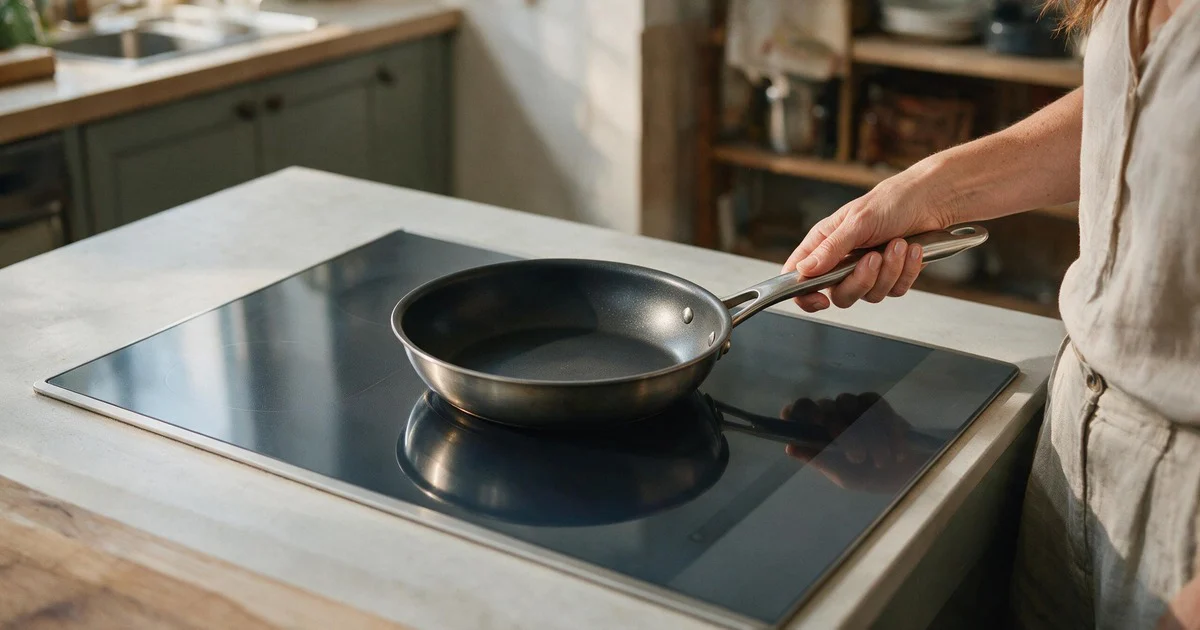
When a Wolf induction zone ignores a pan, test the cookware on another zone first, because the pan is a more common cause than the electronics.
Written for Wolf owners
If a Wolf induction zone will not start with a pan on it, the quickest way to split the cause is to move the pan, then move a different pan. A cookware problem follows the pan from zone to zone; an electronics problem stays with the zone no matter what you put on it. That one comparison tells you whether you need a new pan or a technician.
Induction heats the pan itself, so the cooktop only starts when it recognizes cookware on the surface. Run through a short sequence with the cooktop cool and the glass dry:
If the pan fails everywhere and a second pan works, the first pan is the problem. A pan that fails on one zone only, while a second pan fails there too, points to that zone. If nothing is detected anywhere on the surface, the cause is wider than a single zone.
Check the bottom of the pan as well. A warped base that does not sit flat, a very small pan on a large zone, or a pan with a base that is not magnetic can all be ignored by an induction surface. Holding a kitchen magnet to the base is a simple test of whether the material is magnetic. If the magnet does not hold, the pan is not suited to induction.
Water, spills and cleaner film can confuse the touch controls and make a working zone look dead. Dry the glass completely and check that the control lock is not on. If the zone indicator lights but the pan is not recognized, the controls are responding, and the cause lies in the pan or the zone. If the display does not respond at all, our induction cooktop repair page covers the wider symptoms.
It also helps to confirm the cooktop has power. Wolf’s quick reference for the 15-inch CE152TF transitional electric cooktop lists a 3-wire, 240 VAC, 60 Hz supply and a dedicated 20 amp circuit, which is a reminder that these units rely on a proper supply of their own. If other parts of the cooktop display behave oddly after a power interruption, a breaker reset is the first thing Wolf’s published answers suggest.
None of the cooktop codes in the Wolf answers we have on file says “no pan detected,” so a silent zone may have no code to look up at all. What the list does contain are board-level faults that could affect any zone. Code 30 is a data flash error, a result of flashing software. Code E07 is a model value change. Code E02 is a generator heat sink temperature that is too high, and each lists turning the unit’s breaker off for 30 seconds and back on as the first step.
If one of those appears alongside the pan problem, write it down exactly. If none appears, the display is telling you that the control does not see a fault, and a technician will need to look at how the zone detects cookware.
Three habits cause a lot of needless service calls. The first is sliding a pan to the edge of the zone so that only part of its base sits over the marked circle; centering it fixes that. The second is a wet or greasy pan base that leaves a film on the glass, which can upset the touch controls and not the pan sensing at all. The third is trying a single pan, finding it fails, and concluding that the cooktop is at fault. Always test with a second pan before you decide, and try the zone again after the glass has dried. Write down what you tried in order, because a technician can use that list to skip steps you have already covered.
You cannot see inside the unit, and you should not try. A technician checks the supply, reads any stored fault, tests the zone’s coil and its connection, and checks the board that drives it. The result separates a zone that has lost its heating coil from a board that has stopped driving a healthy one. For the model-specific history of induction ranges, see the pages for IR36551 and IR30451; for related codes, see E4 and E2.
The cooktop heats the pan directly, so the pan material and base matter. A pan with a base that does not suit induction, or that is warped, will be ignored while a better pan works.
No. A single dead zone while the others work usually points to something local to that zone, which a technician can test without replacing the whole cooktop.
It can clear a stuck control state, and Wolf lists it as a first step for several codes, but it will not fix a pan that is unsuitable or a zone that has failed.
Share a few details and we’ll confirm an appointment. Prefer to talk? Call us and we’ll help right away.