
Model-specific diagnosis

About this model
Model overview
The SRT366 is a Current rangetop on the SRT Sealed Burner platform, and its model code together with that platform decides which burner layout and service notes apply.
SRT366 in brief
ModelSRT366
Appliance familyRangetop
Series / platformSRT Sealed Burner
StatusCurrent
Production range(s)2006–Current
Variant(s)SRT366
Sealed burners and the SRT366 layout
A broad complaint on another Wolf generation can come from a different system, so the full model and serial belong on every report about the SRT366. Describe which burner misbehaves and how, since that detail narrows the search.
Common service complaints
Calls about the SRT366 generally fall into these groups:
- A burner clicks but may not ignite, lights slowly, or needs several attempts.
- A flame is weak, uneven, noisy, or unstable at simmer settings.
- Igniters continue clicking after a burner has lit.
- A griddle or charbroiler section, where equipped, may not heat or regulate normally.
- Knob, valve, spark-module, or ignition-switch problems affect one control position.
- Electrical ignition behaves inconsistently even though gas is available.
Treat these as leads, not a parts list. A flame that is weak or lifts at a simmer setting is a different symptom from a burner that will not light.
Symptoms worth documenting
Note these points before changing a setting or unplugging the range:
- One burner behaves differently from the rest.
- The issue is worse after cleaning or a spill.
- You hear continuous clicking with or without flame.
- A burner flame pattern is uneven.
- A specialty cooking section may stop respond normally.
Note whether the fault appears at once, after preheat, under load, in a particular mode or after cleaning. Say whether the trouble began after the range was wiped down.
Owner checks on the SRT366
- Clean and inspect and fully dry the burner heads, caps, and igniter area, then reinstall the parts correctly.
- Look over that burner ports are not blocked by food residue, without enlarging the openings.
- Verify the rangetop has electrical power for spark ignition.
- Compare the affected burner with another burner to see whether the problem is isolated.
- Avoid adjust internal gas valves, regulators, or live ignition wiring yourself.
Gas valves, regulators, manifolds and ignition wiring are technician work, not owner adjustments. Outside checks serve to capture details and rule out obvious outside causes.
Reading an SRT366 display message
Save the exact text on the SRT366 display before clearing it or restarting. The SRT Sealed Burner platform sets the meaning of each code, so a number that matches another Wolf rangetop may refer to something else. A message that returns after a restart calls for model-specific diagnosis, and the knob position and burner in use help make it useful.
Confirm any code against this family and platform first, since visible values repeat across generations.
Stopping the SRT366 when it is unsafe
Stop using the rangetop immediately if you smell unburned gas, see uncontrolled or lifting flames, ignition continues without lighting, or electrical arcing is visible.
An unsafe rangetop should be switched off and left alone instead of restarted to see if the fault clears.
Model-specific diagnostic path
Wolf has reworked controls, sensors, ignition, heating circuits, fans and communication across generations, so the SRT Sealed Burner platform decides which documents and tests apply to the SRT366.
The relevant system scope includes burner ignition, gas delivery, specialty cooking sections where equipped, switches, and control. A spark ignition switch sends the pulse to the electrode for the burner being lit, so a single clicking position is treated differently from a rangetop-wide problem.
A technician may check:
- Ignition electrodes, switches, and spark-module output.
- Burner heads and flame pattern.
- Gas valves, regulator operation, and gas pressure when appropriate.
- Specialty cooking-section heating/control where equipped.
- Electrical supply and internal wiring.
The aim is to tell an outside or installation fault from a control or sensing fault, an ignition or mechanical fault, or a condition specific to this model. Comparing the burner that misbehaves with its neighbors shows whether the fault is isolated.
Repair or replace?
The SRT366 is a current model, so the existing control and safety logic should stay in place. Record the exact model and serial before any component is picked.
Seated, dry burner caps and heads matter before any further conclusion is drawn from a lighting problem.Production is listed as 2006–Current. Replacing a built-in rangetop can also bring cabinetry, trim, wiring or ventilation work, priced apart from the unit.
Getting an SRT366 ready for service in San Francisco
Provide:
- Complete model: SRT366;
- Serial number if available;
- Appliance family: Rangetop;
- Platform: SRT Sealed Burner;
- Exact symptom and when it occurs;
- Error code or message exactly as displayed;
- Safe checks already completed;
- Built-in, heavy, custom-panel, stair, elevator, gate, or controlled-entry access details;
- San Francisco service ZIP code.
Naming the failed part is not the owner’s task. A precise model and a clear note of which burner acts differently, and how, do more good than a guess about the cause.
Questions about the SRT366
The SRT366 can need service on its controls, sensors, heating, ignition, fan, power or communication, depending on the family. Test the symptom before a part is changed.
A single reset is acceptable when no smoke, arcing, overheating, water leak or repeated breaker trip is present. If the same message returns, the SRT366 is still detecting the fault, and more resets will not clear it.
Usually not. A code points to a system or circuit to investigate, and wiring, connectors, power, sensors and controls come before any component is condemned.
The SRT366 is still in production, so repair should keep its control and safety logic intact, with the serial recorded before any part is ordered.
The full model, the serial if known, the symptom, any display code, the burner in question and when the problem appears. For the SRT366, these details narrow the test path.
Ask for SRT366 service
If the symptom survives the safe checks, book Wolf rangetop service for the San Francisco area with SRT366, the symptom, any display message and the ZIP code.
Related serviceRangetop RepairWolf ModelsWolf model libraryWolf Error CodesWolf error codesWolf Repair GuidesRepair guidesContactRequest service
Specifications
| Dimensions | Overall width is 35 7/8 inches. Overall height is 8 1/2 inches. Overall depth is 28 1/2 inches. |
|---|---|
| Power | Electrical supply is 120 VAC, 60 Hz. The unsuffixed model denotes natural gas; propane adds -LP. Total output from serial 18180000 is 95,200 Btu. Total output before serial 18180000 is 84,200 Btu. The current specification lists 1 surface burner rated 9,200 Btu. The current specification lists 2 surface burners rated 15,000 Btu. The current specification lists 2 surface burners rated 18,000 Btu. The current specification lists 1 surface burner rated 20,000 Btu. |
| Installation | A dedicated 15-amp circuit is specified. Gas supply uses a 3/4-inch ID line. Gas inlet size is 1/2-inch NPT. The receptacle is a grounded three-prong type. |
| Features | The cooking configuration is 6 burners. Spark ignition automatically relights an extinguished flame. Continuous grates are cast iron. Production began in 2006. |
| Controls | The standard red knobs provide continuously variable control. |
What sets the SRT366 apart
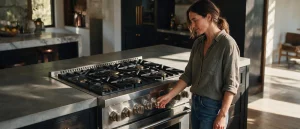
The SRT366 is a 36-inch natural gas rangetop with six sealed burners and continuous cast iron grates, with no griddle or charbroiler taking space on the top. Its burners are rated from 9,200 Btu/hr up to 20,000 Btu/hr in the current specification, so one range covers gentle simmering and hard searing. The unsuffixed model number denotes natural gas, and the -LP version is the propane build. Output totals differ by serial range, so the rating label matters when comparing units.
Service notes for the SRT366
Sealed burners that will not light or keep clicking usually have a damaged igniter, a spark electrode that has shifted, or debris in the burner head, and a technician works through those in that order. Because this top uses spark ignition that relights an extinguished flame, a burner that keeps clicking after the flame is out can point to the flame sensing circuit. Error codes on a zone are checked against the knob or switch assembly before any control is replaced. The owner can wipe the caps, confirm the cast iron grates sit level, and note which burner has the problem. Shut off the gas supply before pulling grates or caps.
Fix it right
Repair service
Models
Other models
Wolf SRT484CG Repair & Troubleshooting in San Francisco
Wolf SRT484DG Repair & Troubleshooting in San Francisco
Wolf SRT484F Repair & Troubleshooting in San Francisco
Wolf SRT486C Repair & Troubleshooting in San Francisco
Wolf SRT486G Repair & Troubleshooting in San Francisco
Wolf RT362F Repair & Troubleshooting in San Francisco
Book a repair
Tell us what’s wrong — we’ll take it from there
Share a few details and we’ll confirm an appointment. Prefer to talk? Call us and we’ll help right away.
Phone
(415) 691-2576
Hours
Mon–Sat: 8:00 AM – 7:00 PM
Service area
San Francisco Bay Area, California